
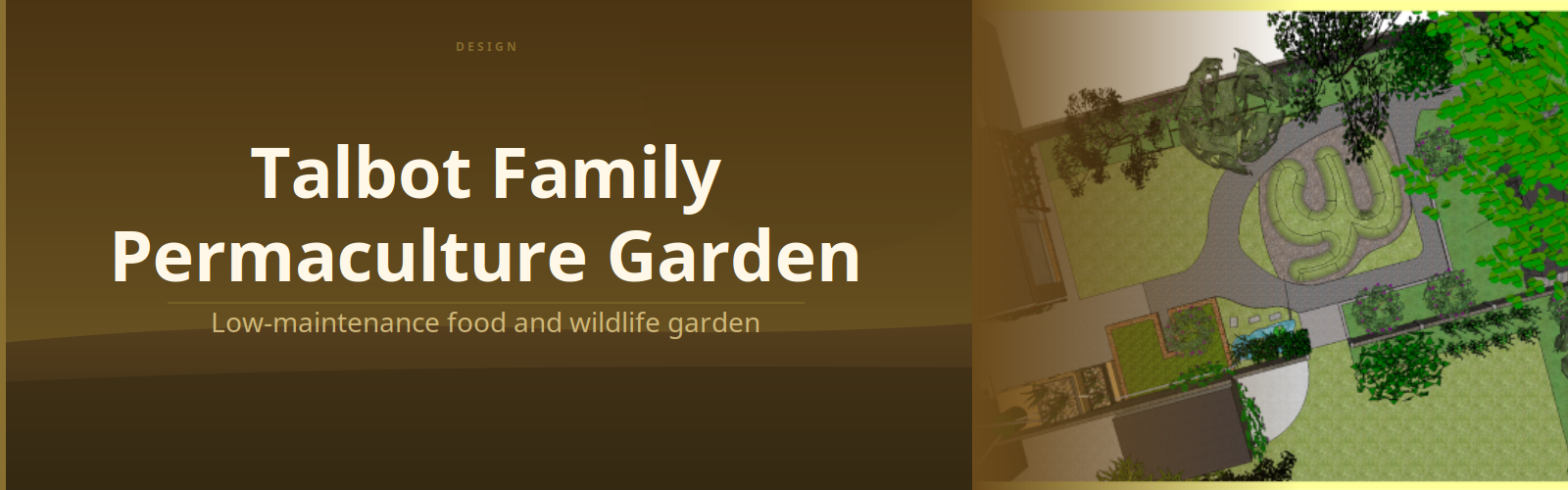
Overview
This project transforms the neglected garden of the house I grew up in into a productive, low-maintenance urban forest garden. After moving out in 1989, the property was let to tenants who never maintained the garden. For over twenty years the only "management" was a contractor visiting a few times a year to cut everything back to bare soil.
When I finally gained access in Autumn 2011, I had the opportunity to redesign the space properly. The analysis of the adjacent permaculture garden (next door) had already identified this garden as a zone 3–4 space — somewhere not visited daily. A forest garden, which sustains itself once established, was the obvious and fitting solution.
Methodology
Because a forest garden design is inherently simpler than a full permaculture design — the layered structure itself provides the framework — I chose the lighter CEAP methodology rather than the more elaborate SADIM or OBREDIM. The simplicity of CEAP matched the nature of the task well.
Working Through the Design
-
1
Collect — Site Survey & Information Gathering
A thorough survey was conducted using mind maps (Xmind) to systematically look at the site from multiple angles: geology, soil, history, sun/shade, wind, and existing plants.
Site History
Goodmayes was largely arable land until urbanisation between 1898–1910, coinciding with the opening of Goodmayes Railway Station in 1901. Historical maps show Talbot Gardens remained as orchards and tree nurseries as late as 1944. This orchard heritage supports tree growing on site.
Geology & Soil
Bedrock is London Clay Formation with Hackney Gravel above. Soil is sandy-silty loam with pH 6.5–6.7, ideal for fruiting trees and shrubs.
Base Maps & Microclimates
Using Google Sketchup, wind and frost patterns were modelled. Two mature trees were present: a 60-year-old apple and a pear, plus an elder from a neighbouring garden.
Sun & Shade Analysis
Sketchup sun/shade models at equinoxes and solstices revealed seasonal light availability across the garden.
-
2
Evaluate — Making Sense of the Data
Site data was evaluated to guide plant selection, layout, and management. A PASTE analysis (Plants, Animals, Structures, Tools, Events) showed high groundwater, orchard heritage, and good soil pH support a productive forest garden with minimal soil amendments.
🌿 Permaculture PrincipleExisting mature trees are gifts to design from. Keeping and working with thriving elements applies use and value diversity and use edges and value the marginal. -
3
Apply — Design Development
Rak's Forest Garden Design Methodology was applied, layering the forest garden from canopy to ground cover, following permaculture principles.
-
4
Plan & Implement
The implementation plan was followed as closely as practical, adapting for materials and timing. Early planting and establishment phases were documented, showing layers developing into a low-maintenance, food-producing garden.
Reflections & Outcomes
Transforming a neglected back garden into a productive forest garden demonstrates working with nature rather than against it. The orchard heritage, good soil, and existing mature trees made the forest garden approach logical and effective.