
Tools and Resources
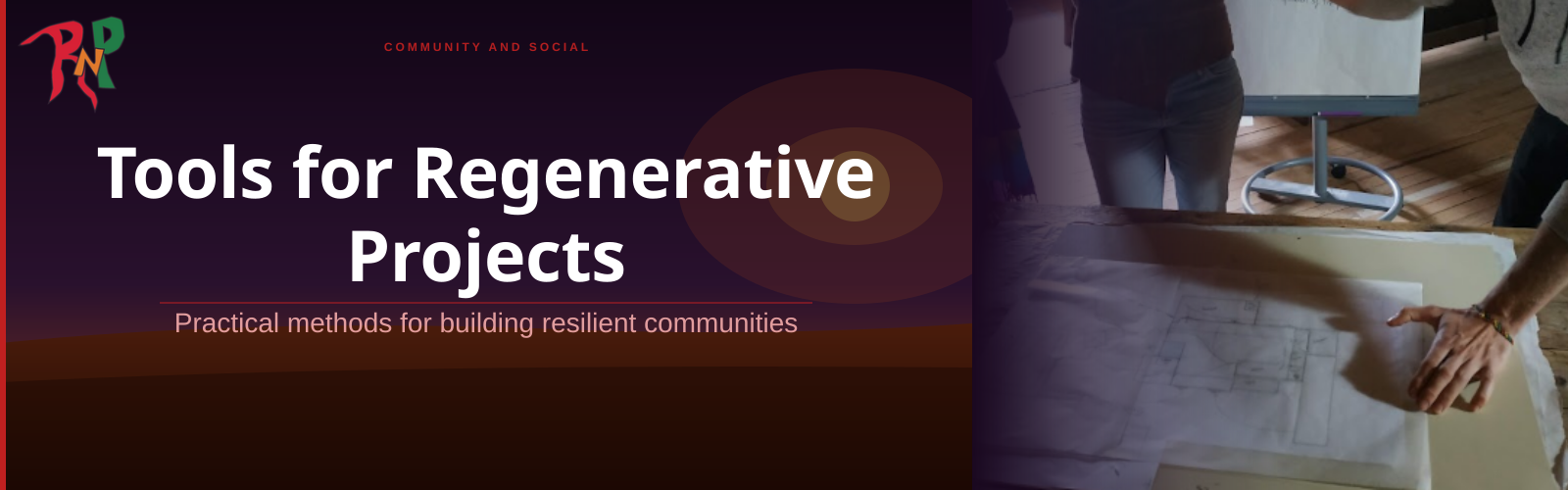
The Tools and Resources section of the Knowledge Base is a curated collection of practical tools, frameworks, and approaches drawn from real-world regenerative work.
Whether you are starting a new initiative or developing an existing one, this section brings together proven approaches to help you organise projects, design resilient systems, and collaborate in ways that are clear, inclusive, and effective.
Explore the categories
This section is organised into three key areas, each focusing on a different aspect of regenerative projects and collaboration. You can explore them directly below:
- Community Building Tools: Approaches for bringing people together, strengthening relationships, and creating shared purpose within groups and neighbourhoods, such as facilitation methods, group agreements, and communication practices.
- Permaculture Tools: Practical design methods, observation techniques, and planning frameworks to help you work with nature and create resilient, productive systems, including site analysis, zoning, and pattern-based design.
- Governance Tools: Structures and decision-making processes that support collaboration, fairness, and effective group organisation, such as consent-based decision making and role-based governance.
Not sure where to start?
If you're new to this work, a good place to begin is with Community Building Tools, as strong relationships form the foundation of any successful project.
If you already have a group or project underway, explore Permaculture Tools for design methods, or Governance Tools to support decision-making and organisation.
How to use this section
These resources are designed to be flexible and adaptable. You can use them as step-by-step guides, as inspiration for your own processes, or as reference material to deepen your understanding.
Many of the tools can be combined to suit your specific context, whether you are working on a small garden project, a community initiative, or a larger regenerative design.
Learn, adapt, and apply
The aim of this section is not to provide rigid instructions, but to offer practical support that you can shape to your own situation. Every place and community is unique, and these tools are most effective when used with careful observation and thoughtful application.
This is a living resource that will continue to grow over time, shaped by real projects, experiences, and evolving practice. As new tools are tested and refined, they will be added here to support others on a similar path.
Choose a category, explore a tool, and begin applying it in your own context.